Wetlands in northwestern Mexico, the key to the survival of the Pacific Red knot
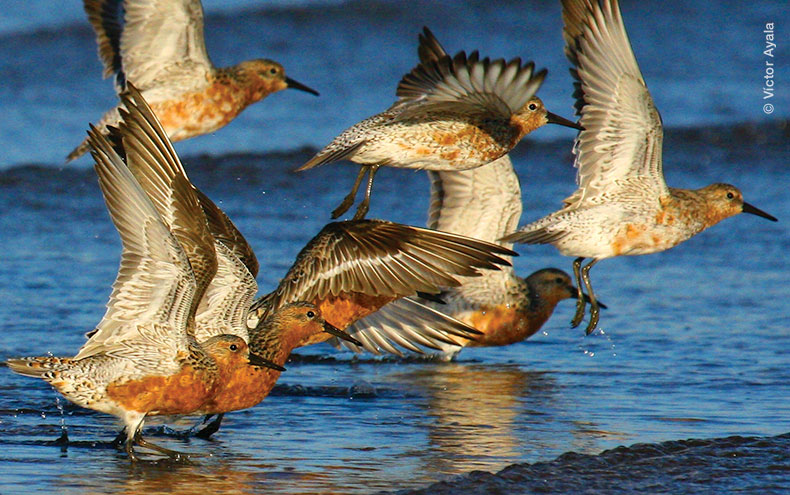
Scientific research developed across the continent has revealed a decline in the populations of various species of shorebirds. One of the most rapidly-declining species is the Pacific Red knot (Calidris canutus roselaari), with estimates of fewer than 10,000 individuals remaining.
40% of the Pacific Red knot population prefers to winter in the wetlands of northwestern Mexico: Guerrero Negro (Baja California Sur), Golfo de Santa Clara (Sonora) and Marismas Nacionales (Sinaloa and Nayarit).This has sparked a 10-year research program, in which Pronatura Noroeste and the Autonomous University of Baja California Sur (Universidad Autónoma de Baja California Sur) have joined forces for the study and conservation of this species.
As part of this program, in 2013 and 2014 we documented 6,000 Red Knots feeding on the eggs of Gulf grunions (Leuresthes sardina) in the sandy beaches of Golfo de Santa Clara, in Sonora. This ecological phenomenon is very similar to the event in Delaware Bay, in the United States, where the Atlantic Red knot consumes the eggs of Horseshoe crabs. In both cases, ingestion of the eggs provides the birds with the energy necessary to complete their migration between the reproduction and wintering areas.
Through a process of information, education, promotion of beach protection measures and tourism management at Golfo de Santa Clara, we strive to prevent the disturbance of the Red knots during their feeding time, which is essential if they are to complete their migratory cycle.
Latest news
You can find here the latest news of Pronatura Noroeste.
View more